
Maritime English Pronunciation
In this section, we will first discuss the role of Nautical
English within Maritime English, where intelligible and
comprehensible English pronunciation plays a crucial role in
ensuring safe navigation. We will then focus particularly on
radio communication between ship and ship as well as between
ship and shore conducted by captains and deck officers.
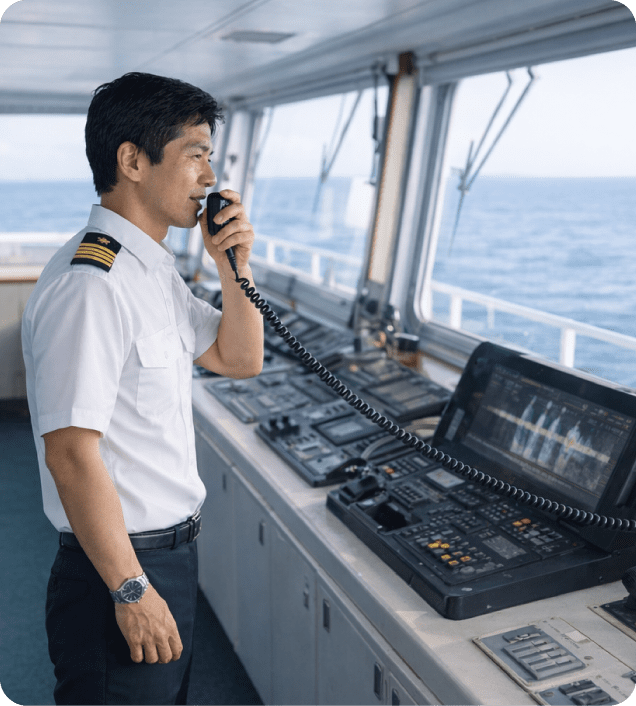


Overview of Maritime English
1.1 What Is Maritime English?
Maritime English is defined as the English used by seafarers on ocean-going vessels during voyages and in ports, as well as by professionals engaged in the shipping and shipbuilding industries [1] Bocanegra-Valle, A. (2013). Maritime English. In C. A. Chapelle (ed.) The Encyclopedia of Applied Linguistics. (pp. 3570–3583). Oxford: Wiley-Blackwell. . It is classified as English for Specific Purposes (ESP).
More specifically, Maritime English is used in the following areas:
-
Nautical English and
Marine Engineering English -
Marine Engineering
-
Shipping Business
-
Maritime Law




1.2 Maritime Shipping in Japan
The shipping industry underpins modern international trade. Merchant mariners and shipping professionals are responsible for safely guiding vessels across national and regional boundaries, delivering cargo efficiently while protecting the marine environment and safeguarding the economic interests of all related companies and stakeholders.
As an island nation, Japan depends heavily on imports for energy resources (such as crude oil and natural gas), industrial raw materials (such as iron ore), and food (such as wheat and soybeans). Approximately 99.6% of Japan’s total trade volume (exports and imports combined) is transported by merchant vessels [2] 海事広報活性化協議会 (2026). 海と船の情報ポータルサイト:海ココ https://c2sea.jp/sea-goto/shipping/ (2026年2月7日 最終閲覧) . A merchant vessel’s crew consists of the captain and officers (deck officers, chief engineer, engineers, radio officers, etc.) as well as ratings. In Japan, captains and officers are classified as “ship officers.” To become a ship officer, one must pass the national Maritime Officer Certification Examination, complete the required Maritime License Training Course according to rank, and obtain a Maritime Officer’s Certificate.
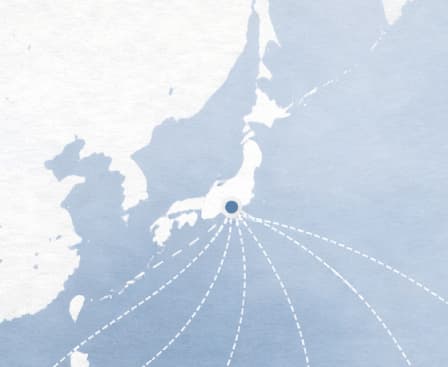
1.3 Ship Operations on a Global Stage
Ship operations are inherently international, and it is not uncommon for multiple countries and cultures to be involved in a single vessel’s operation. For example, a ship’s country of construction, flag state, owner, ship management company, charterer, cargo origin, and crew nationalities may all differ. Among the major Asian maritime nations, fleets substantially owned by Asian shipping companies account for 46.8% of the world’s total tonnage, with China and Japan together accounting for 50.6% of that share. Meanwhile, the top-three flag states globally are Panama, Liberia, and the Marshall Islands. Major seafarer-supplying countries include the Philippines, China, and Indonesia.
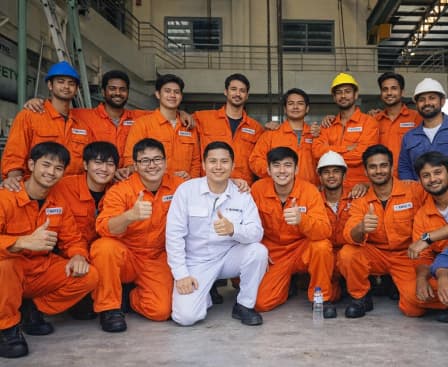
Focusing on countries relevant to Japanese seafarers (as of 2025) [3] 日本海事広報協会 (2025). 日本の海運 SHIPPING NOW 2025-2026. https://www.kaijipr.or.jp/shipping_now/ (2026年2月16日 最終閲覧) , Japan imports crude oil mainly from Middle Eastern countries; iron ore, coal, and LNG primarily from Australia; LPG from the United States and Canada; soybeans from the United States, Brazil, and Canada; and wheat from the United States, Canada, and Australia, each exceeding 99% in combined share. A cargo vessel typically operates with around 20 crew members. However, only 1.6% of the crew members in the Japanese merchant fleet are Japanese nationals, compared to 68.4% Filipino and 14.3% Indian crew members. Mixed crews, with Japanese captains and chief engineers working with foreign seafarers, are the norm.
1.4
The Importance of English in Multilingual and
Multicultural Contexts
In such globally interconnected workplaces, English serves as the common working language. Since miscommunication can directly lead to serious maritime accidents, appropriate use of English for safe navigation is indispensable.
The STCW Convention (International Convention on Standards of Training, Certification and Watchkeeping for Seafarers) [4] International Maritime Organization (1993). STCW 1978: International Convention on Standards of Training, Certification and Watchkeeping for Seafarers, 1978: with Resolutions Adopted by the International Conference on Training and Certification of Seafarers, 1978. London: IMO. requires maritime education institutions worldwide to ensure that deck cadets acquire the following knowledge and skills in English (Table A-II/1):
-
Using charts and other nautical publications
-
Understanding meteorological information and messages concerning ship’s safety and operation
-
Communicating with other ships and coast stations and performing an officer’s duties with a multilingual crew, including the ability to use and understand the Standard Marine Communication Phrases (SMCP)



The SMCP
(Standard Marine Communication Phrases)
2.1 What Is the SMCP?
Seafarers are expected to demonstrate competence in all aspects of English, but speaking and listening skills are especially critical. Even when deck officers have different native languages and varying levels of English proficiency, they must communicate smoothly via radio in all settings: on board, ship-to-ship, and ship-to-shore/shore-to-ship, in order to ensure safe navigation. Therefore, the International Maritime Organization (IMO) established the Standard Marine Communication Phrases (SMCP) [5] International Maritime Organization (2002). IMO Standard Marine Communication Phrases. London: IMO. [6] 髙木直之・内田洋子 (2002). 『海事英語基礎』東京:海文堂. in 2002. Under the STCW Convention (1.4), maritime training institutions worldwide are required to teach the SMCP to deck cadets.
In Japan, the SMCP is included in the Advanced Navigation English Training Course within the Maritime Officer License Training Course (1.2).
2.2 Devices to Ensure Clarity
The SMCP incorporates various devices—including grammatical simplification— to render communication accessible to speakers of diverse English proficiency levels and to ensure clarity in noisy operational environments.
1 Spelling out letters
A = Alpha, B = Bravo, C = Charlie, …, Z = Zulu
Under noisy conditions, letters such as S /és/ and F /éf/, or P /píː/ and T /tíː/, may be difficult to distinguish. Therefore, they are communicated by spelling them out as follows:
-
This is MV Intelligibility, call sign, Juliet, Bravo, Alpha, Sierra, Papa. Over.
2 Pronouncing numbers individually (except for helm orders such as “Port/Starboard fifteen”)
-
Position one five degrees three four minutes North, zero six one degrees two nine minutes West.
-
My draft is 11.3 (one one point three) metres.
3 Use of message markers
To clarify communicative intent and prevent misunderstanding, one of eight message markers (Instruction, Request, Advice, Warning, Question, Answer, Request, Intention) is placed at the beginning of a message.
-
INSTRUCTION. Do not cross the fairway.
-
REQUEST. I require two tugs.
-
ADVICE. Stand by on VHF channel six nine.
4 Full-sentence responses after Yes/No
-
Do you require medical assistance? – Yes, I require medical assistance.
-
Is the sea state expected to change? – No, the sea state is not expected to change.
5 Avoidance of contractions
-
I’m underway. → I am underway.
-
Don’t cross the fairway. → Do not cross the fairway.
6 Avoidance of ambiguous modal verbs
-
May I enter the fairway? → QUESTION. Do I have permission to enter the fairway?
-
You could be running into danger. → WARNING. You are running into danger.
7 Use of standardized phrases
Expressions such as “stand by,” “over,” “mistake,” “correction,” and “repeat” enhance clarity:
-
Stand by on VHF Channel 14 until pilot transfer is completed.
-
I have a list to port of 2 degrees. Over.
-
My present speed is 14 knots – mistake. Correction, my present speed is 13, one-three, knots.
2.3 Grammatical Considerations
The grammatical foundation of the SMCP is the same as that of general English. Therefore, accurate command of basic grammar is essential. Frequently used structures include imperatives, Yes-No questions, WH-questions and their responses, as well as appropriate use of tense, aspect, mood, voice, and verb forms.
Here is an example showing the importance of using basic grammar accurately. While on watch, for safe navigation it is essential to accurately report the situations of nearby vessels, as follows.
-
Vessel A is overtaking us. (present progressive)
-
Vessel A has overtaken us. (present perfect)
-
We were overtaken by Vessel A. (past passive)
-
We are being overtaken by Vessel A. (present progressive passive)
Complex grammar is not necessary. It is important to be able to use adverbial clauses expressing time and conditions (e.g., I expect to refloat when the tide rises.), but it is unlikely that you will need to use the subjunctive (e.g., I would expect to refloat if the tide rose.).
2.4 Lexical Considerations
On board a vessel, not only are specialized terms and expressions necessary for navigation (e.g., Mayday, bearing, person overboard) used, but even seemingly simple words may differ from their meanings in general English.
-
port (side), starboard (side) (< left, right)
-
galley (< kitchen)
-
funnel (< chimney)
Some terms differ in meaning. For example, in general English casualty refers to an injured or dead person, whereas in maritime usage casualty (fatality) and injured person are distinguished. Abbreviations are also common. Some are pronounced as acronyms (e.g., ECDIS, EPIRB, RADAR), while others are read letter by letter (e.g., IMO, ETA, GMDSS).
Many of these technical terms are used in Japanese as katakana loanwords, so they often do not need to be learned as new English vocabulary: e.g., ナビゲーション (navigation), ドラフト (draught), サーチ・アンド・レスキュー (search and rescue). However, mismatches can occur. For instance, the quay structure called ビット /bi.t.to/ for bitt in Japanese refers to what is called a bollard in English, while the twin posts on deck called ボラード /bo.ra.a.do/ for bollard in Japanese correspond to bitt in English. As the referents are reversed, careful attention is required.
The Sounds of the SMCP:
Points for Listening
3.1 Understanding Diverse English Accents
When entering or leaving port, ocean-going vessels communicate by radio in English with the Vessel Traffic Service (VTS). Listening to such exchanges in Tokyo Bay reveals the wide range of English proficiency levels and native-language backgrounds among ship officers. They communicate confidently in their own national accents—pronunciations influenced by their first languages. It is striking how VTS operators manage congested traffic despite strong accents. Radio communication thus constitutes a rich source of non-native English varieties. What phonetic and phonological features characterize these varieties? How do Japanese seafarers perceive them? What features are perceived as “accented”? And how might these perceptions differ from those of native English speakers?
To clarify these issues, a contrastive analysis of Japanese, standard English pronunciation, and the respective first languages of non-native speakers is necessary.
The following sections discuss the phonetic and phonological features of three English varieties with which Japanese maritime officers are likely to come into contact in their professional duties, and analyze key listening considerations for native speakers of Japanese.
3.2 Understanding Diverse English Accents: Philippine English [7] Takagi, N., & Uchida, Y. (2011). Phonetic characteristics of Filipino mariners’ English. IMEC-23 Proceedings, 193–199.

Two datasets were collected: (a) readings of the alphabet and SMCP sentences used in radio communication by maritime university students, and (b) spontaneous speech by instructors recounting their navigational experiences. As numerous languages are spoken within the Philippines, speakers were not limited to any particular first-language background. Both native speakers of British English and native speakers of Japanese (the authors) listened to the recordings. Referring also to previous studies on Philippine English [8] Comrie, B. (1990).The world’s major languages. London: Oxford University Press. , they identified the following features:
Consonants
- /f/ → [p]: coffee → “copy,” chief engineer → “cheap engineer,” different → “diperent,” foreigner → “poreigner”
- /r/ → tap [ɾ] or trill [r], especially after vowels (e.g., hard, anchor)
- Word-final /p, t, k/ → [ʔ] or deleted
- /θ, ð/ → [t, d]: think → “tink,” thing → “ting”; the → “da,” this → “dis”
- /z/ → [s]: You must use your eyes. → “You must use your ice.”
- /v/ → [b, w]: every → “ebery,” vessel → “bessel”; very → “wery”
- Word-final /tʃ, dʒ/ → [ts, dz]: which → “wits,” bridge → “bridz”
- Other examples: India → /ɪ́ndʒə/, Sierra → /ʃiér/ (influence from Tagalog)
Vowels
- Spelling pronunciation causing weak vowels to become strong vowels:
officer, quarter [er]; anchor, color, motor [or] - The final syllable of -ation being pronounced as [on]: communication, situation
- Other tendencies: Tagalog /a/ used for English /æ/ (e.g., man, bank)
- Difficulty with diphthongs (e.g., main, alone); /ɪ/ → /iː/ (e.g., river, dinner)
Rhythm
- Use of mora-timed rhythm
Many comments by native speakers of Japanese pertained to segmental features (individual vowels and consonants), whereas native speakers of English frequently highlighted insufficient vowel reduction in unstressed syllables and rhythm-related issues.
3.3 Understanding Diverse English Accents: Chinese English [9] 内田洋子・髙木直之 (2012). 「中国語話者の英語訛りの研究:日本人海事従事者のために」『日本航海学会論文集』126, 55–64.

We recorded general English sentences, the alphabet used in radio communication, and SMCP sentences spoken primarily by maritime university students who were native speakers of Northern varieties of Chinese. After a contrastive analysis of Chinese and English [10] Chang, J. (2001). Chinese speakers. In M. Swan & B. Smith (Eds.), Learner English: A teacher’s guide to interference and other problems (2nd ed., pp. 310–324). Cambridge University Press. , both native English speakers and native Japanese speakers listened to the recordings. The following features were reported as deviations from standard English. Items marked with * were perceived as “accented” by native speakers of Japanese as well; unmarked items were noted only by native English listeners.
Consonants
Strong influence from the Chinese distinction between aspirated and unaspirated voiceless stops
- *Deletion or quality modification of postvocalic /l, r/: Alpha, call, Delta, Golf; wear, four, fourteen
- */b, d, ɡ/ → [p, t, k]: boatswain (→ /po.o.su.ɴ/), back [p]; danger, do [t]; go, again [k]
- */v/ → [w]: vessel (→ /we.s.se/), Bravo, drive, Five, November, Seven, Seventy, Victor
- */θ, ð/ → [t, d]: thirteen, thirty, three; the, that, they
- */h/ → [x]: help, he, heaven
- /θ, ð/ → [s, z]: thought, anything, bath; there, with
- /z/ → [dz]: Zulu
- Confusion of /l/ and /r/ before vowels: rig, pilot boat, Romeo
- Deletion of /h/ in pronouns his, her
Vowels
- *Unsystematic deviations from expected vowel quality: buoy (→ /bo.i.o/), Echo (→ /a.i.ko.u/, /i.i.ko.u/), Eight (→ /a.i.to/), Fire (→ /fe.a.a/), Four (→ /fa.u/), Fourteen (→ /fa.u.ti.i.ɴ/), shower (→ /ʃo.u/), Spain (→ /su.pa.i.ɴ/, /su.pa.ɴ/)
- /e/ → quality close to /ʌ/: heaven, help, get, any, many
- /eɪ/ realized within the /e/ category: Spain, plain, came
- /aʊ/ deviating from expected quality: how, about, downtown
Syllable Structure
Vowel insertion in consonant clusters and after word-final consonants, and deletion of word-final consonants
- *Deletion of word-final consonants: Juliet → Julie_, Foxtrot → Foxtro_, Uniform → Unifor_, crude → cru_, Nine → Ni_
- *Vowel insertion (non-target quality): aft → aft[a], boat → boat[a], fast → fast[a], flag state → flag[a] stat[a]
- Vowel insertion (target-like quality): book → book[u], cab → cab[u], help → help[u]
Other Features
- *Medial consonant deletion: Six → si_s, Sixteen → Si_teen, knots → kno_s
- *Deletion plus insertion: present → presen_ → presen[a]
- Put seven shackles. → Put[a] seven shackles. (potential reinterpretation as “Put a seven shackles”)
3.4 Understanding Diverse English Accents: Korean English [11] 内田洋子・髙木直之 (2013). 「韓国人海事英語の音声的特徴について:日本人が感じる外国語訛り」『日本航海学会論文集』129, 45–49.

The data consist of recordings of the alphabet and SMCP sentences used in radio communication, pronounced by maritime university students who are speakers of the Seoul dialect (primarily younger speakers). Native Japanese university students aspiring to become deck officers listened to the recordings. Based on documented phonetic features of Korean English [12] Lee, J. A. (2001). Korean speakers. In M. Swan & B. Smith (Eds.), Learner English: A teacher’s guide to interference and other problems (2nd ed., pp. 325–342). Cambridge University Press. , the following deviations from standard English were identified. Items marked with * were perceived as “accented” by native Japanese listeners.
Consonants
Influence of the Korean three-way contrast among lenis, aspirated, and tense consonants, and intervocalic voicing of lenis consonants between voiced sounds
- /f/ → [p]: *Alpha, *Golf, *Uniform, *Fifteen, *Fifty, *flag, *after, *aft
- /z/ → [dʒ]: *Zulu, *zero
- Word-initial and word-final voiced consonants devoiced: Bravo [p], Delta [t], Golf [k], Juliet [tʃ]
- Word-medial voiceless consonants becoming voiced: 𝜙
- /l, r/ → [ɾ] syllable-initially, [l] syllable-finally: Bravo, Charlie, Golf, Kilo, Lima, Romeo, Sierra, Three, Eleven, flag, last, rig
- /v/ → [b]: November
- Confusion of /s, ʃ/ before high front vowels /ɪ, iː/: Sierra, Six, Sixteen, sinking
- /θ/ → [s]: Three, Thirteen, Thirty
- /ð/ → [d]: this, the
Vowels
English has over 20 vowels; Korean has 7.
- /æ/ → [e]: *Tango, *anchor, *last
- /oʊ, ɔː/ → [oː]: Bravo, Echo, Kilo, Romeo, *Tango, boat
- /ʌ/ → [ɑ]: 𝜙
- No distinction between walk and work; work /ɚː, əː/ → [ɔː, ə]: 𝜙
Syllable Structure
Vowel insertion in consonant clusters and after word-final consonants, and deletion of word-final consonants
- Vowel insertion (unexpected phonetic value): Foxtrot → *Foxt[u]rot[u], aft → *aft[a], eight → eight[u]
- Vowel insertion (expected phonetic value): X-ray → eks[u]-ray, Mike → Mik[u]
- Word-final consonant deletion: Foxtrot → *Foxtro_, Juliet → *Julie_, Quebec → *Quebe_, eight → *eigh_, Titanic → *Titani_, vessel → *vess_ (syllable deletion)
Other Features
- Deviations from expected Japanese katakana equivalents: *November (→ /no.be.ɴ.bo.o/), *Victor (→ /bi.ku.to.o/), *Thirty (→ /so.o.ti.i/)
- Excessively short final syllables: *Bravo (→ /bu.ra.bo/), *Charlie (→ /tʃa.a.ri/), *Echo (→ /e.ko/); *-teen in numbers (→ /ti.ɴ/)
- *Characteristic rising and falling intonation patterns when reading the alphabet
3.5
“Accents” as Perceived by
Native Speakers of Japanese
Japanese seafarers, as non-native speakers of English, listen to other non-native speakers. Their judgment of whether an accent is present appears to be influenced by comparison with their own Japanese-accented English. The “perceptual sieve” through which they process English seems relatively coarse. For example, owing to Korean influence, English /æ/ may be realized as [e], and /s/ before /iː/ as [ɕ]. Thus, tanker [teŋka] may sound like /te.ɴ.ka.a/ and sea [ɕiː] like /si.i/ [ɕii]. While a native English listener might perceive both as accented, Japanese listeners may perceive only tanker—which deviates from their expected sound value—as accented.
A similar pattern appears in syllable structure. Native speakers of Chinese, whose languages favor open syllables, may insert vowels or delete final consonants when pronouncing English closed syllables. For example, Juliet may be pronounced as Juliet[a] or Julie_. Japanese listeners tend to perceive the latter (deletion) as more strongly accented than the former (insertion), possibly because Japanese speakers themselves often insert vowels to create open syllables but rarely delete consonants. Moreover, deletion of a final /t/ reduces informational content, requiring additional effort from the listener to reconstruct the word.
Research on Philippine English also reveals striking differences between native and non-native listeners. Japanese listeners are sensitive primarily to segmental deviations, that is, deviations in vowels and consonants, whereas native English listeners are more concerned with suprasegmental features such as rhythm and stress. Insufficient vowel reduction in unstressed syllables and equal syllable timing can obscure stress contrasts and hinder comprehension. This suggests a tendency for native listeners to rely more on top-down processing, and non-native listeners more on bottom-up processing.
As discussed, the English speech of non-native speakers deviates from the American English that is often used as a model in elementary, junior high, and high school education. Additionally, it differs from the phonetic values that Japanese native speakers themselves expect. Therefore, in maritime communication, it is beneficial to understand the phonological characteristics of various English varieties and acquire familiarity through repeated exposure. Further research is required to determine the extent to which reported phonetic discomfort actually affects safety-critical communication.
3.6
Native-Speaker English Is Not
Necessarily Easier to Understand
[13]
Uchida, Y., & Takagi, N. (2012). What did you say? ― Why communication failures occur on the radio. IMEC-24 Proceedings, 170–179.
Is English spoken by native speakers necessarily easier to understand?
Apparently not.
A survey of 28 Vessel Traffic Service (VTS) operators in Tokyo asked them to rate intelligibility of English used by radio operators from 16 countries on a 7-point scale (1 = very easy to understand; 7 = very difficult). The nationalities fell into three groups:
As reported, the most difficult to understand were Ukrainian (5.86) and Russian (5.81), followed by Chinese (5.14) and American (4.90). The easiest were Filipino (3.50), Indian (3.20), Korean (3.04), and Singaporean (3.00).
Reported causes of difficulty included radio equipment issues (Russia) and vocabulary and expression choice (Chinese and Korean seafarers using inadequate expressions; American and British seafarers using overly sophisticated expressions). Despite the existence of SMCP as a shared communicative tool, failure to master or adhere to it, particularly by native speakers, appears to contribute to communication problems.
Furthermore, factors related to speech were also identified. These included not only “accents” (e.g., Chinese and Russian), but also the speed of native speakers’ speech. For English spoken by Americans (4.90), British speakers (4.29), and Australians (4.20), responses indicating that “the speech is too fast” were frequently reported. Reports included comments such as: “They do not slow down or adjust their expressions even when asked to repeat,” and “Some laughed or shouted when they were not understood.” The relatively large standard deviations indicate wide variation in perceived intelligibility. Thus, native-speaker English cannot automatically be considered easy to understand.
The overwhelmingly common suggestion for achieving “easy-to-understand English” was: speak slowly, clearly, and distinctly. Doing so may mitigate difficulties caused by accent. Other suggestions included spelling out words and, for native speakers, acquiring experience in learning and using a foreign language in order to better understand the challenges of communication across linguistic boundaries.
Pronunciation of SMCP Terms from the Perspective of
“Intelligible and Comprehensible Pronunciation”
4.1 The Importance of “Intelligible and Comprehensible Pronunciation”
Accurate communication in radio communication is often difficult for deck officers who do not share the same first language; nevertheless, it is indispensable for the prevention of maritime accidents. In order to ensure safety of life at sea and to meet the English language proficiency requirements stipulated in the STCW Convention and Code, the International Maritime Organization (IMO) has developed Model Courses [14] International Maritime Organization (2015). IMO Model Course 3.17: Maritime English. London: IMO. to facilitate effective communication among seafarers. According to these materials, approximately 90% of communication failures are attributed to phonetic and phonological inaccuracies, underscoring the significance of pronunciation training. At the same time, regarding the accents of non-native speakers, the guidelines state that such accents are acceptable as long as the speaker’s utterances are understandable, and that non-native accents are permissible provided that the English used is intelligible and comprehensible. However, what types of pronunciation qualify as “understandable” remains vague.
In the field of second language speech education, two major constructs have been proposed as indicators of intelligible and comprehensible pronunciation: intelligibility and comprehensibility [15] Derwing, T. M., and Munro, M. J. (2015). Pronunciation fundamentals: Evidence-based perspectives for L2 teaching and research. Amsterdam: John Benjamins Publishing Company. :
Indicator 1
Intelligibility
―
The degree of match between
a speaker’s intended message and the listener’s comprehension
Indicator 2
Comprehensibility
―
The ease or difficulty a listener experiences
in understanding an utterance
Intelligibility can be measured by asking listeners to spell out what they have heard, whereas comprehensibility can be assessed using psychological rating scales that capture perceived difficulty of understanding.
In what follows, we examine intelligibility and comprehensibility by analyzing the pronunciation of SMCP terms produced by Japanese-native deck cadets. Specifically, we describe the phonetic characteristics of their speech, present the recordings to native speakers of American English, and measure intelligibility and comprehensibility. We then observe and describe the relationships among phonetic features, intelligibility, and comprehensibility, as well as possible individual differences among speakers and listeners. Finally, we discuss implications for effective pronunciation instruction in ESP contexts.
4.2
Pronunciation of SMCP Terms by Japanese Native Speakers:
Phonetic Characteristics
[16]
Uchida, Y., & Sugimoto, J. (2022). Phonetic characteristics of Maritime English terms pronounced by Japanese deck cadets. Proceedings of the 36th General Meeting of the PSJ. 145-150.
As previously noted (Section 2.4), many maritime technical terms are commonly used as katakana loanwords in Japanese. However, katakana pronunciations often differ from their English counterparts for various reasons, and using them without modification may result in communication breakdown. Moreover, listeners who attempt to perceive English input through the filter of katakana-based phonological knowledge may experience additional difficulty in comprehension.
The study introduced here investigated how SMCP terms that are frequently used as katakana loanwords are pronounced when produced in English. Thirty students from a maritime university whose first language was Japanese (Group A = 15; Group B = 15) were asked to pronounce the following 65 words in English.
Wordlist for Group A
alarm, astern, barometer, bow, briefing, buoy, call, cargo, clear, container, control, deck, emergency, freeboard, full, hold, iceberg, information, kilometer, launch, liferaft, meter, mile, oil, order, port, pump, radar, request, rudder, smoke, starboard, tool, trim, turbine
Wordlist for Group B
ahead, anchor, ballast, berth, boat, bridge, channel, course, crew, damage, diesel, draft, ETA, fairway, ladder, lifeboat, light, local, message, officer, pilot, pirate, proceed, propeller, ship, signal, speed, system, team, tug
A contrastive analysis of the produced words revealed two types, characterized by the phonetic features outlined below. The numbers in parentheses indicate how many of the 15 responses exhibited the feature in question.
In the lists below, * indicates words whose intelligibility ranged between 40% and 60% in the listening experiment described in Section 4.3, and ** indicates words whose intelligibility was below 40%.
Type 1 Words difficult to pronounce because of sounds absent from the Japanese phonological system
For example, ladder /lǽdɚ/ and rudder /rʌ́dɚ/ are both represented as ラダー /ra.da.a/ in Japanese, yet they differ in English in both the initial consonant (/l/ vs. /r/) and the vowel (/æ/ vs. /ʌ/). As Japanese does not systematically distinguish these contrasts, such deviations are often referred to as “global errors” [17] Szpyra-Kozłowska, J. (2015). Pronunciation in EFL instruction: A research-based approach. Bristol: Multilingual Matters. .
Consonants
- Confusion of /l/ and /r/, and use of the Japanese /r/ (alveolar tap [ɾ]): *clear (14), kilometer (14), *crew (13), **freeboard (13), *request (13),
**rudder (13), control (12), *draft (12), *briefing (11), *liferaft (11), *pirate (10), **radar (10) - Dark /l/ → [ɾ]: **hold (14), *oil (12), control (12), **mile (11), **full (10)
- /θ/ → [s]: **berth (11)
- /s/ (+ /ɪ, iː/) → [ʃ]: emergency (13), system (12), signal (9), proceed (4)
Note: /ʃ/ → [s]: ship (2) - /f/ in most cases realized as the bilabial fricative [ɸ]: *briefing, **fairway, **freeboard, **full, information, lifeboat, *officer
Vowels
- /æ, ʌ/ → Japanese /a/: *liferaft (14), **rudder (12), *anchor (11), **ladder (8)
- Loss of rhoticity in r-colored diphthongs: **port (15), order (14), **course (13), starboard (13); emergency (15),
**turbine (14), iceberg (11); *cargo (15); *clear (14) - /oʊ/ → [oː]: **old (14), boat (9), smoke (4), local (2)
- /ɪ/–/iː/ contrast realized primarily as a length distinction ([i]–[iː]): **bridge, information, ship, signal, system,
**trim; *briefing, **diesel, ETA, **freeboard, proceed, speed, *team
Vowel Insertion
- Epenthetic vowels inserted in consonant clusters (increase in syllable count): *clear (12), control (12), **freeboard (11),
*briefing (10), *draft (10), **propeller (10)
Note: No vowel insertion observed in most word-final consonants (e.g., ahead, *alarm, boat, **bridge, *draft, ship); exceptions: *briefing [-ŋk(u)], [-ŋɡ(u)] (10)
Vowel Devoicing
- Devoicing of high vowels between voiceless consonants (reduction in syllable count): *officer [oɸi̥saa] (15)
Type 2 Word-Specific Pronunciation Issues Not Fully Explained by the Japanese Phonological System
In addition to global errors, there are pronunciation deviations specific to individual words. For example, while tea and teacher are realized as /ti.i/ and /ti.i.tʃa.a/ in Japanese, team has become established as “chīmu.” Consequently, when pronounced in English, it may be realized as [tɕiːm], which approximates /tʃiːm/ rather than /tiːm/. Such katakana-induced deviations [18] Matsuura, H., Rilling, S., Chiba, R., Kim, E-Y. J., Rini, N. (2017). Intelligibility and comprehensibility in English as a lingua franca: Nativized English in Japanese. Asian Englishes, 19, 2–21. are referred to as “local errors” [17] Szpyra-Kozłowska, J. (2015). Pronunciation in EFL instruction: A research-based approach. Bristol: Multilingual Matters. . These include the following:
Certain Pronunciations Become Conventionalized as Katakana Loanwords
- **tool (9) ツール [tsuuru] (< トゥール [tuuru]), *team (8) チーム [tʃiimu] (< ティーム [tiimu]), *channel (6) チャンネル /tʃa.ɴ.ne.ru/ (< チャネル /tʃa.ne.ru/),
*pirate (3) パイレーツ /pa.i.re.e.tsu/ (< パイロット /pa.i.ro.t.to/) - The second syllable is not reduced (stress becomes less distinct): **ballast (13) バラスト /ba.ra.su.to/ [-ast], message (3) メッセージ /me.s.se.e.ji/ [-eɪdʒ], *damage (2) ダメージ /da.me.e.ji/ [-eɪdʒ]
- Palatalization: *deck (6) デッキ [-kj]
- Insertion of a devoiced vowel: **port (2) ポート [pooto̥]
- Source word is not originally English: **pump /pʌ́mp/ → ポンプ /po.ɴ.pu/ (< パンプ /pa.ɴ.pu/), from Dutch “pomp”
Influence of Spelling
- Romanized pronunciation: **launch (7) [-au-], kilometer (7) [-ee-], meter (7) [-ee-], *barometer (5) [-ee-]
※ “meter” may also be pronounced with [eɪ]: *barometer (5), kilometer (3), meter (1) - Possible influence of analogy with familiar words: **ballast (13) “last”;
*pirate (11) “rate”; *damage (9), message (9) “age”
※ No such analogy observed for cargo: *cargo (9) [ɡo], or vowel-deleted form *cargo (1) [ɡ]
In many cases, global and local errors occur simultaneously. For example, in channel, the first-syllable /æ/ and the word-final /l/ are realized as [a] and [ɾ], respectively, under the influence of Japanese (global errors). At the same time, the medial /n/, although it could in principle be produced as a single [n] (as in チャネル /tʃa.ne.ru/), tends to be realized in accordance with the established loanword form チャンネル /tʃa.ɴ.ne.ru/ in Japanese (a local error). Consequently, the word is pronounced with a degree of deviation that is quite noticeable in English.
However, from the standpoint of “intelligible and comprehensible pronunciation,” the ultimate criterion is whether intelligibility and comprehensibility reach sufficiently high levels. Therefore, Section 4.3 presents the results of the listening experiment measuring how these SMCP terms were actually perceived.
4.3
Pronunciation of SMCP Terms by Japanese Native Speakers:
Intelligibility
[19]
Uchida, Y., & Sugimoto, J. (2023). Intelligibility of Maritime English terms pronounced by Japanese deck cadets. Proceedings of the 20th International Congress of Phonetic Sciences, 4259–4263.
Intelligibility was measured for the 65 SMCP terms produced by the 30 deck cadets described in Section 4.2 (65 words × 15 speakers). Tokens were randomly presented one at a time, and 65 native speakers of American English listened via headphones and spelled out what they heard.
The percentage of correct spellings for each word was taken as its intelligibility score. As noted in Section 4.2, words marked with * showed intelligibility between 40% and 60%, while those marked with ** fell below 40%. The results indicate that not only global errors rooted in phonological system differences but also locally established katakana pronunciations frequently led to reduced intelligibility. These findings highlight the significance of producing katakana loanwords “as English” in maritime communication contexts.
When comparing words with high and low intelligibility, several tendencies emerged. As expected, monosyllabic words with limited phonetic cues were more vulnerable to misperception; a single deviation could easily result in perception as a minimal pair or an entirely different word (e.g., berth misheard as bus, boss, pass, or bath). Interestingly, although consonant clusters absent in Japanese are often assumed to be difficult, words beginning with /s/ + consonant clusters (e.g., smoke, starboard, speed) demonstrated relatively high intelligibility.
| SMCP Terms | Intelligibility Score (%) | Incorrect Responses (3 or more; 10 or more underlined with count in parentheses) |
Notes |
|---|---|---|---|
| High intelligibility (80% or above): 8 words | |||
| information | 92.3 |
|
|
| smoke | 92.3 | smog | |
| container | 89.2 | ||
| control | 86.2 | ||
| starboard | 85.5 | ||
| emergency | 83.1 | ||
| ETA | 82.8 | ||
| speed | 81.5 | speak | |
| Low intelligibility (below 20%): 13 words | |||
| course | 18.5 | coast (29), cause, calls, close |
|
| mile | 16.9 | mine (15), might, light, my, mind | |
| propeller | 15.4 | prepare, crocodile | |
| astern | 15.2 | astound, Boston, master | |
| call | 12.3 | cold (21), coal (16), cord, code, car | |
| fairway | 10.9 | railway, away, ferry | |
| turbine | 10.8 | cabin, bobbing | |
| radar | 9.2 | ladder (12), rudder, brother | |
| freeboard | 8.8 | ||
| tool | 7.7 | two (19), tube, tooth, dude, sea, soon | |
| trim | 6.2 | three (14), dream (12), tree, toilet | |
| berth | 1.9 | bus (13), boss, pass, bath | |
| full | 1.5 | crew, fruit, hurry, who | |
Among the remaining 44 words not shown in the table above, several were also frequently misheard. Below is a list limited to words that received more than 10 incorrect responses (the numbers in parentheses indicate the number of misperceptions):
Items frequently misidentified
(number of responses in parentheses)
anchor → uncle (29); port → boat (21); crew → clue (14); bridge → breach/breech (13), reach (12); clear → career (12), Korea (12); draft → raft (12); alarm → around (11); bow → boat (10); order → older (10)
An analysis of these misperceptions reveals which of the deviations observed in Section 4.2 contributed to reduced intelligibility:
Issues contributing to reduced intelligibility
- Vowel-related issues: Rhoticity
- Consonant-related issues: Dark /l/
- Voicing-related issues: Insufficient aspiration; insufficient devoicing of /r/
- Syllable structure issues: Vowel insertion in consonant clusters; Deletion of initial consonants in clusters
Analysis of additional misperceptions not listed above suggests that overlapping errors have a substantial impact on intelligibility. For example, misplacement of lexical stress alone did not necessarily reduce intelligibility (bárometer, cóntrol were generally identified accurately). However, when stress misplacement co-occurred with vowel insertion in consonant clusters, intelligibility was markedly reduced (e.g., bridge [búrɪdʒ] → porridge; trim [tórɪm] → current). Further investigation is required to determine how such overlapping errors, particularly when reinforced through established katakana loanwords, affect intelligibility.
The mean intelligibility score for Group A was 44.5% (SD = 9.4), whereas that for Group B was 48.9% (SD = 8.0), indicating substantial individual differences. The manner in which speakers produced the words appears to have influenced intelligibility. Let us now compare four representative speakers.
-
Speaker A09
Intelligibility Score: 71.1%
Pronunciation oriented toward “English-like” production
-
Speaker A02
Intelligibility Score: 37.0%
Katakana-like pronunciation
(e.g., turbine [ta.a.bi.ɴ] → misheard as tavern, cabin, caravan; tool [tsu.u.ru] → misheard as soon, Sue) -
Speaker B08
Intelligibility Score: 62.6%
Pronunciation retaining traces of Japanese-accented English, but produced clearly and slowly
-
Speaker B12
Intelligibility Score: 34.8%
Pronunciation retaining traces of Japanese-accented English, combined with a muffled or unclear voice quality
Even among Japanese learners, substantial individual differences were observed. These findings highlight the significance of identifying the relationship between each learner’s phonetic characteristics and intelligibility, and of developing individualized methods to improve intelligibility.
4.4
Pronunciation of SMCP Terms by Japanese Native Speakers:
Comprehensibility
[20]
内田洋子・杉本淳子 (2023). 「日本人航海士の海事用語発音:アメリカ英語母語話者による「わかりやすさ」の評価」『第37回日本音声学会全国大会予稿集』172–177.
Additionally, comprehensibility was measured for 15 of the 65 words (briefing, cargo, channel, damage, ladder, launch, meter, oil, pilot, pirate, radar, rudder, team, tool, and trim). Fifty-eight native speakers of American English who had participated in the intelligibility task described in Section 4.3 participated in this evaluation. Each participant evaluated five words. The target word was displayed on a screen, and participants listened to 15 different speakers’ productions of that word, one at a time. They rated each token on a 5-point scale (1 = very difficult to understand; 5 = very easy to understand). After completing the 15 ratings for a word, participants were asked to provide written comments explaining the basis of their evaluations. For these 15 words (15 speakers per word), the average intelligibility and comprehensibility scores are shown in the table. Intelligibility represents the percentage of correct spellings, while comprehensibility represents the mean rating on the 1–5 scale (1 = very difficult; 5 = very easy), along with its degree of variability. Relatively high scores/ratings are marked with *, and relatively low scores/ratings with * .
| Word | Intelligibility Score | Comprehensibility Rate (SD) | Word | Intelligibility Score | Comprehensibility Rate (SD) | Word | Intelligibility Score | Comprehensibility Rate (SD) |
|---|---|---|---|---|---|---|---|---|
| meter | *60.0 | *3.28 (0.65) | pilot | 50.8 | 2.78 (0.68) | ladder | 32.3 | 2.76 (0.50) |
| cargo | *55.4 | *3.03 (0.82) | team | *46.2 | *3.83 (0.41) | rudder | 26.4 | 2.76 (0.73) |
| damage | *55.4 | *3.02 (0.61) | briefing | *44.6 | *3.19 (0.60) | radar | *9.2 | *2.07 (0.89) |
| oil | 52.3 | *2.44 (0.87) | pirate | 40.0 | 2.86 (0.76) | tool | *7.7 | *2.57 (0.75) |
| channel | 52.3 | *2.59 (0.44) | launch | 35.4 | 2.98 (0.81) | trim | *6.2 | *2.66 (0.74) |
Although the analysis is based on a limited set of 15 words, radar, tool, and trim (low intelligibility and low comprehensibility) clearly emerge as high-priority targets for pronunciation instruction. Additionally, oil and channel (adequate intelligibility but low comprehensibility) also require instructional attention. By contrast, meter, cargo, and damage (high intelligibility and high comprehensibility) were found to be relatively easy and communicatively successful words; thus, from the standpoint of pronunciation instruction, they would be of lowest priority. (As for team and briefing, the results showed relatively high comprehensibility despite not necessarily high intelligibility, suggesting the need for further investigation.)
As with intelligibility, substantial individual differences were observed in comprehensibility. The table below presents comprehensibility ratings for nine words produced by the 15 speakers in Group A. Even among the top-three highest-rated speakers, individual variation is evident. For example, Speaker A05 received very high ratings for oil (4.90) and launch (4.70), but considerably lower ratings for rudder (2.00) and briefing (2.28). A03 showed similar variability, whereas A09 displayed comparatively little fluctuation.
Variation was also observed across words. For example, although meter received the highest overall rating (3.28), it included both highly rated tokens (A03: 4.55; A09: 4.50) and relatively low-rated tokens (A15: 2.50; A12: 2.30). A similar pattern was identified for lower-rated words such as tool, oil, and radar. For instance, radar included a highly rated token (A09: 4.22) as well as very low-rated tokens (A07: 1.28; A04/A15: 1.39; A03/A11: 1.50).
| Comprehensibility by speaker | Comprehensibility by speaker and word | ||||||||||
|---|---|---|---|---|---|---|---|---|---|---|---|
| Speaker | Mean | SD | meter | briefing | cargo | launch | rudder | trim | tool | oil | radar |
| A09 | 3.81 | 0.54 | 4.50 | 3.94 | 3.22 | 3.65 | 4.06 | 3.00 | 4.39 | 3.30 | 4.22 |
| A05 | 3.27 | 1.03 | 3.15 | 2.28 | 3.67 | 4.70 | 2.00 | 2.61 | 3.56 | 4.90 | 2.56 |
| A03 | 3.10 | 1.21 | 4.55 | 4.17 | 3.67 | 1.45 | 4.33 | 2.83 | 3.39 | 2.05 | 1.50 |
| A06 | 3.08 | 0.67 | 3.20 | 3.67 | 3.44 | 2.80 | 2.94 | 4.06 | 3.11 | 2.85 | 1.67 |
| A13 | 2.98 | 0.77 | 3.10 | 3.28 | 3.67 | 3.80 | 2.78 | 1.56 | 1.94 | 3.15 | 3.56 |
| A07 | 2.88 | 1.00 | 4.05 | 3.56 | 3.61 | 3.50 | 2.94 | 3.39 | 2.11 | 1.50 | 1.28 |
| A14 | 2.65 | 0.83 | 3.15 | 3.06 | 1.06 | 3.50 | 3.44 | 2.72 | 2.94 | 2.40 | 1.61 |
| A04 | 2.57 | 0.79 | 3.35 | 3.11 | 3.22 | 3.05 | 1.89 | 3.22 | 2.33 | 1.55 | 1.39 |
| A10 | 2.53 | 0.65 | 3.20 | 3.44 | 3.00 | 2.95 | 2.44 | 1.61 | 2.00 | 2.25 | 1.83 |
| A11 | 2.51 | 0.57 | 2.80 | 2.89 | 3.11 | 2.50 | 2.72 | 3.06 | 1.72 | 2.30 | 1.50 |
| A01 | 2.50 | 0.51 | 3.15 | 1.89 | 2.72 | 2.80 | 2.83 | 1.89 | 2.17 | 2.00 | 3.06 |
| A15 | 2.46 | 0.61 | 2.50 | 2.89 | 3.22 | 3.20 | 2.06 | 2.44 | 2.61 | 1.85 | 1.39 |
| A02 | 2.46 | 0.73 | 2.80 | 3.44 | 3.72 | 2.00 | 1.89 | 1.50 | 2.17 | 2.40 | 2.22 |
| A08 | 2.42 | 0.81 | 3.45 | 3.44 | 1.28 | 2.70 | 2.61 | 2.94 | 2.22 | 1.60 | 1.56 |
| A12 | 2.38 | 0.44 | 2.30 | 2.72 | 2.89 | 2.10 | 2.39 | 3.00 | 1.94 | 2.45 | 1.67 |
| Comprehensibility by word |
Mean | 3.28 | 3.19 | 3.03 | 2.98 | 2.76 | 2.66 | 2.57 | 2.44 | 2.07 | |
| SD | 0.65 | 0.60 | 0.82 | 0.81 | 0.73 | 0.74 | 0.75 | 0.87 | 0.89 | ||
| Word-level intelligibility (%) | 60.00 | 44.62 | 55.38 | 35.38 | 26.42 | 6.15 | 7.70 | 52.31 | 9.23 | ||
Criteria for Judging Comprehensibility
Finally, regarding the basis on which comprehensibility was judged (i.e., “What criteria did you use to evaluate comprehensibility?”), the following categories were identified from the responses. The numbers in parentheses indicate the number of respondents out of 56.
- /l/: tool (16), oil (15), channel (9), launch (5), ladder, pilot (2)
- /r/: pirate (10), rudder (9), briefing (5), radar (2), trim (1)
- Rhoticity: meter (12), cargo (8), ladder (6), rudder (2)
- Consonants other than /l/ and /r/: pilot (5), launch (4), cargo, meter, pirate (2), briefing, ladder (1)
- Vowels: launch (11), radar (10), trim (6), meter (5), team, tool (1)
- Vowel epenthesis: trim (6), briefing (3)
- Minimal pairs: pilot ⇔ pirate (13)
- Stress: cargo (5), pirate (3), channel, ladder (2)
- Syllables: oil (2)
The listening experiments described in Sections 4.3 and 4.4 yielded numerous insights. Most notably, even learners who share the same first language display substantial individual variation. This suggests that pronunciation instruction should be tailored to each learner’s specific characteristics.
Nevertheless, several issues remain unresolved. In this study, the listeners were native speakers of American English. How would listeners with different linguistic backgrounds evaluate the same speech? Without addressing this question, it is impossible to fully discuss what constitutes truly intelligible Maritime English pronunciation. Furthermore, if listeners were limited to professional seafarers, their perception might differ. For example, trim was misheard as three or dream, which may partly reflect the fact that non-seafarer listeners are relatively unfamiliar with the word trim in a maritime context. It would also be valuable to investigate how evaluation might change if listeners heard words embedded in sentences, or within realistic communicative contexts. Future research is required to explore these issues.
For Safe Navigation:
Intelligible and Comprehensible
Pronunciation
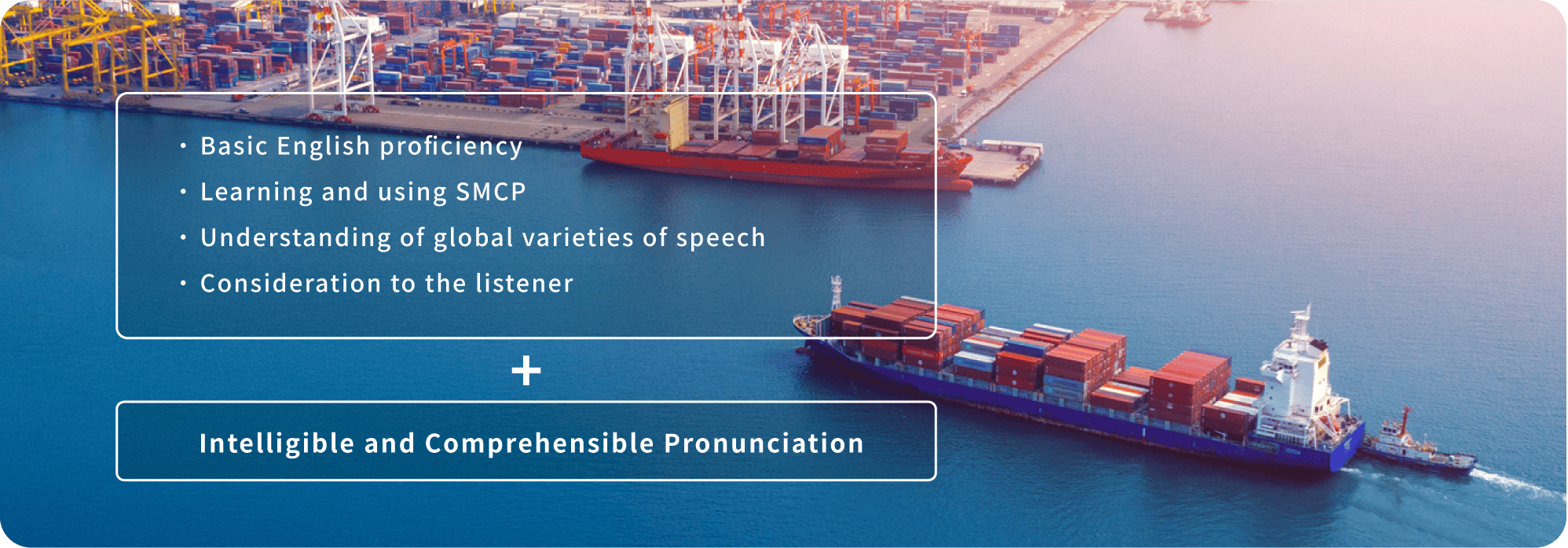
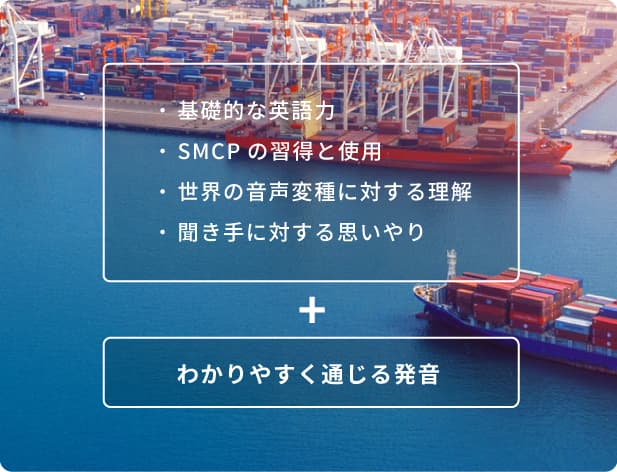
In ship operations, even a single miscommunication in radio communication can lead to a major accident. Therefore, explicit and intelligible English is essential. Its foundation is basic English proficiency; however, Maritime English as an ESP uses a more limited range of vocabulary than general English, and the expressions employed are context-specific, which can actually facilitate comprehension. Additionally, SMCP standardizes the phrases to be used, and faithful adherence to them ensures clarity. Furthermore, it is crucial to develop an understanding of global varieties of speech and to show consideration for the listener.
Consider a simple example: reporting to the captain that a pilot boat is approaching the vessel during port entry. Lexically, the correct term is pilot boat. Grammatically, since it refers to a single boat, the indefinite article a would ordinarily be required. However, because SMCP often simplifies grammatical structures, inclusion or omission of the article may not be critical. As the action is ongoing, the present progressive form is used. Given the situational context of port entry procedures, a slow and clear pronunciation should ensure successful communication: “(A) pilot boat is approaching.” It is sometimes joked that Japanese speakers must be careful not to say pirate boat instead of pilot boat because of /l/–/r/ confusion. Yet with basic vocabulary knowledge, grammatical awareness, and contextual support, communication failure can be avoided.
That said, striving to produce maritime terminology, including SMCP terms, with accurate vowels, consonants, and stress patterns is a key aspect of professional seamanship. Pilot /páɪlət/ and pirate /páɪrət/ form a minimal pair, differing by only one sound, and confusion of /l/ and /r/ can indeed affect communication. In the unlikely but serious event of encountering pirates, one would wish to calmly report: “I am under attack by pirates.”
Mastery of maritime terminology involving spoken communication requires not only knowledge of spelling and meaning but also awareness of its phonological form [21] 内原卓海 (2022年6月).「第2音声語彙習得と教授」JACET SLA SIG. オンライン講演会. . Learners must attend both to systematic pronunciation difficulties (global errors) and to the original English pronunciation of words that have become established as katakana loanwords (local errors). Overcoming the fossilized influence of katakana forms presents considerable difficulty for many Japanese learners of English. Doing so requires attentive listening to authentic speech, attention to vowels, consonants, and stress patterns, and repeated oral practice.
Finally, we hope that these findings will contribute to the safe navigation of vessels across the world’s oceans.
Acknowledgments
- This section was supported by JSPS KAKENHI Grant Number 21K00566.
- We would like to express our sincere gratitude to Professor Emeritus Hideo Yabuki of the Tokyo University of Marine Science and Technology for his valuable comments and suggestions on this section.
References
-
[1]
Bocanegra-Valle, A. (2013). Maritime English. In C. A. Chapelle (ed.) The Encyclopedia of Applied Linguistics.
(pp. 3570–3583). Oxford: Wiley-Blackwell. -
[2]
海事広報活性化協議会 (2026). 海と船の情報ポータルサイト:海ココ
https://c2sea.jp/sea-goto/shipping/ (2026年2月7日 最終閲覧) -
[3]
日本海事広報協会 (2025). 日本の海運 SHIPPING NOW 2025-2026.
https://www.kaijipr.or.jp/shipping_now/ (2026年2月16日 最終閲覧) -
[4]
International Maritime Organization (1993). STCW 1978: International Convention on Standards of Training, Certification and Watchkeeping for Seafarers, 1978:
with Resolutions Adopted by the International Conference on Training and Certification of Seafarers, 1978. London: IMO. -
[5]
International Maritime Organization (2002). IMO Standard Marine Communication Phrases. London: IMO.
-
[6]
髙木直之・内田洋子 (2002). 『海事英語基礎』東京:海文堂.
-
[7]
Takagi, N., & Uchida, Y. (2011). Phonetic characteristics of Filipino mariners’ English. IMEC-23 Proceedings, 193–199.
-
[8]
Comrie, B. (1990).The world’s major languages. London: Oxford University Press.
-
[9]
内田洋子・髙木直之 (2012). 「中国語話者の英語訛りの研究:日本人海事従事者のために」『日本航海学会論文集』126, 55–64.
-
[10]
Chang, J. (2001). Chinese speakers. In M. Swan & B. Smith (Eds.), Learner English: A teacher’s guide to interference and other problems
(2nd ed., pp. 310–324). Cambridge University Press. -
[11]
内田洋子・髙木直之 (2013). 「韓国人海事英語の音声的特徴について:日本人が感じる外国語訛り」『日本航海学会論文集』129, 45–49.
-
[12]
Lee, J. A. (2001). Korean speakers. In M. Swan & B. Smith (Eds.), Learner English: A teacher’s guide to interference and other problems
(2nd ed., pp. 325–342). Cambridge University Press. -
[13]
Uchida, Y., & Takagi, N. (2012). What did you say? ― Why communication failures occur on the radio. IMEC-24 Proceedings, 170–179.
-
[14]
International Maritime Organization (2015). IMO Model Course 3.17: Maritime English. London: IMO.
-
[15]
Derwing, T. M., and Munro, M. J. (2015). Pronunciation fundamentals: Evidence-based perspectives for L2 teaching and research.
Amsterdam: John Benjamins Publishing Company. -
[16]
Uchida, Y., & Sugimoto, J. (2022). Phonetic characteristics of Maritime English terms pronounced by Japanese deck cadets.
Proceedings of the 36th General Meeting of the PSJ. 145-150. -
[17]
Szpyra-Kozłowska, J. (2015). Pronunciation in EFL instruction: A research-based approach. Bristol: Multilingual Matters.
-
[18]
Matsuura, H., Rilling, S., Chiba, R., Kim, E-Y. J., Rini, N. (2017). Intelligibility and comprehensibility in English as a lingua franca:
Nativized English in Japanese. Asian Englishes, 19, 2–21. -
[19]
Uchida, Y., & Sugimoto, J. (2023). Intelligibility of Maritime English terms pronounced by Japanese deck cadets.
Proceedings of the 20th International Congress of Phonetic Sciences, 4259–4263. -
[20]
内田洋子・杉本淳子 (2023). 「日本人航海士の海事用語発音:アメリカ英語母語話者による「わかりやすさ」の評価」『第37回日本音声学会全国大会予稿集』172–177.
-
[21]
内原卓海 (2022年6月).「第2音声語彙習得と教授」JACET SLA SIG. オンライン講演会.